CANADA'S FIRST RESPIRATORY PERFORMANCE ASSESSMENT & TRAINING CENTRE .
Signed in as:
filler@godaddy.com
The Science Behind The Breathing Lab
Every Athlete Trains Their Body…
They build stronger legs.
A more powerful core.
Better balance.
More explosive speed.
Greater endurance.
Sharper skills.
Improved nutrition.
Faster recovery.
Mental toughness.
Yet one of the body's most important performance systems is often overlooked…
**The muscles responsible for breathing.**
Every second of every game, shift, race, round, or competition depends on one thing:
Your body's ability to move oxygen efficiently and remove carbon dioxide while working under increasing physical stress.
Without oxygen, muscles fatigue.
Decision making slows.
Reaction time decreases.
Recovery becomes more difficult.
Performance suffers.
That's why we created **The Breathing Lab.**
Our mission is to help athletes better understand one of the most important—but often least measured—systems in human performance.
---
Breathing Is More Than Simply Getting Air Into Your Lungs
Most people believe breathing is automatic.
They're right.
But performing at an elite level is not automatic.
During intense exercise, the body demands dramatically more oxygen than it does at rest.
The harder an athlete works…
The faster the respiratory muscles must work.
The diaphragm.
The intercostal muscles.
The accessory muscles of breathing.
These muscles are working every second you're competing.
Just like your quadriceps…
Just like your hamstrings…
Just like your heart…
Your breathing muscles experience fatigue.
The question becomes…
**Can they perform efficiently when your body needs them most?**
Why Oxygen Matters
Your muscles don't create energy on their own.
They require oxygen to produce the energy needed for movement.
The better your body is able to transport oxygen…
The better it can support sustained physical activity.
As exercise intensity increases, your respiratory system works harder to meet those demands.
Although many factors influence athletic performance—including cardiovascular fitness, muscular strength, technique, nutrition, sleep, and genetics—the respiratory system plays an important supporting role in helping the body respond to exercise.
Understanding how this system performs provides another valuable piece of information for athletes and coaches.
---
Your Breathing Muscles Can Become Fatigued
Most athletes understand muscle fatigue.
Your legs get tired.
Your shoulders burn.
Your grip weakens.
The same thing can happen to the muscles involved in breathing during prolonged or intense exercise.
When breathing becomes more demanding, these muscles must work harder.
Researchers have spent decades studying how respiratory muscle function changes during exercise and whether targeted respiratory muscle training can improve breathing efficiency and exercise tolerance in certain athletes.
While individual responses vary, this growing body of research has contributed to increasing interest in respiratory muscle training as one component of athletic development.
Why We Measure Instead of Guess
At The Breathing Lab…
We believe performance should never be based on assumptions.
Objective measurements allow athletes and coaches to establish a baseline, monitor changes over time, and evaluate progress using consistent assessment methods.
Rather than relying only on how an athlete feels, measurable information provides another perspective that can support training decisions.
That's why every assessment begins with professional testing and ends with a detailed performance report.
Small Improvements Create Big Results
Championships are rarely won because one athlete became 50% better overnight.
They're won because athletes improve one percent at a time.
One better stride.
One faster recovery.
One smarter decision.
One extra shift.
One stronger finish.
Elite performance is built through the accumulation of small improvements.
Respiratory performance may be one of those improvements.
When combined with quality coaching, strength training, conditioning, nutrition, recovery, and skill development, understanding how an athlete breathes provides another opportunity to monitor progress and support long-term development.
Science Continues to Evolve
Sports science is constantly advancing.
Researchers continue to study how respiratory muscle training, breathing efficiency, and exercise performance relate to different sports and different athletes.
Some studies have reported improvements in measures such as perceived breathing effort, exercise tolerance, and specific performance outcomes following structured respiratory muscle training programs, while results can vary depending on the athlete, sport, and training methods.
At The Breathing Lab, we believe in staying informed by current evidence while recognizing that no single training method guarantees success.
Our goal is to use objective asse Why The Breathing Lab Exists
We didn't build The Breathing Lab because breathing is trendy.
We built it because every athlete deserves access to objective information about an important part of their performance.
We believe athletes should know where they stand.
We believe coaches should have measurable data.
We believe parents should understand how their athlete is developing.
Most importantly…
We believe every athlete deserves every opportunity to improve.
The Breathing Lab was created to help athletes breathe with greater awareness, train with greater purpose, and measure progress with confidence.
Because when everything else has been trained…
There is still one more system worth understanding.
Your breathing.
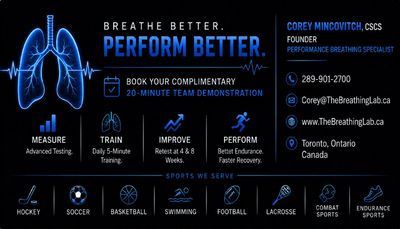
What Does the Research Say?
Respiratory muscle training has been studied for decades.
Researchers around the world have investigated how the muscles involved in breathing respond to training and whether improving respiratory muscle strength and endurance can support athletic performance.
Below are examples of findings that have been reported across published research. Individual results vary, and no single study applies equally to every athlete or every sport.---
Respiratory Muscles Respond to Training
Like other skeletal muscles in the body, the muscles responsible for breathing can adapt to structured training. Research has shown that respiratory muscle strength and endurance can improve with consistent, progressive training programs.
Breathing Muscles Can Fatigue During Intense Exercise
Studies have demonstrated that the muscles involved in breathing can become fatigued during prolonged or high-intensity exercise, particularly in demanding endurance and intermittent sports.
Stronger Breathing Muscles May Reduce the Feeling of Breathlessness
Several studies have reported that respiratory muscle training may reduce an athlete's perceived breathing effort during exercise, allowing some individuals to feel more comfortable during demanding training sessions.
Respiratory Muscle Training May Improve Exercise Tolerance
Published research has found that some athletes are able to maintain demanding exercise for longer periods following structured respiratory muscle training programs.
Recovery Between High-Intensity Efforts Matters
Rapid recovery is critical in many sports. Research continues to investigate how respiratory efficiency may influence recovery between repeated bouts of high-intensity exercise. Every Athlete Responds DifferentlyScientific studies consistently show that athletes do not all respond the same way to any training program. Genetics, sport, age, training history, and overall fitness all influence individual results. Measuring a Baseline Is Valuable
Sports science emphasizes the importance of establishing baseline measurements before beginning a training program. Objective data allows progress to be monitored over time rather than relying solely on subjective impressions. Small Improvements Can Matter
Elite sport is often decided by very small margins. Research across sports performance has demonstrated that incremental improvements accumulated over time can contribute to meaningful competitive advantages. Respiratory Training Complements Existing Programs
Current evidence suggests that respiratory muscle training is best viewed as an additional component of athletic development—not a replacement for strength training, conditioning, skill development, nutrition, or recovery. Monitoring Progress Helps Guide Training
Repeated assessments allow athletes and coaches to compare results over time, identify trends, and make informed decisions based on measurable performance data. Better Information Supports Better Decisions Objective testing provides coaches with another source of information that can complement traditional performance measures such as strength, speed, agility, endurance, and recovery. Youth Athletes Can Benefit From Proper Assessment
For developing athletes, establishing an early baseline allows future performance to be monitored as they grow, mature, and progress through different levels of competition. Respiratory Performance Is One Part of the Bigger Picture No single measurement predicts athletic success. Respiratory performance is one of many factors—including skill, strength, conditioning, nutrition, sleep, recovery, and mindset—that contribute to overall performance. Sports Science Continues to Evolve
New research is published every year. As our understanding of respiratory physiology and athletic performance grows, assessment methods and training strategies continue to improve. Why The Breathing Lab Follows the Research
At The Breathing Lab, our goal is not to chase trends or make unrealistic promises.
Our goal is to combine objective testing, evidence-informed practices, and practical experience to help athletes and coaches better understand respiratory performance and track progress over time. Science provides the foundation.
Assessment provides the data.
Training provides the opportunity.
Progress provides the evidence.
Evidence Center
The Science Supporting Respiratory Performance
At **The Breathing Lab**, we believe athletes and coaches deserve more than opinions—they deserve information supported by scientific research.
Over the past several decades, researchers around the world have investigated respiratory muscle training, breathing efficiency, lung function, exercise tolerance, and recovery in both recreational and elite athletes.
No single study proves everything. Likewise, no single training method guarantees success for every athlete. However, when many well-designed studies begin reporting similar findings, they help build a stronger understanding of how the respiratory system contributes to athletic performance.
Below is a selection of research topics that have shaped our understanding of respiratory performance. Each summary has been written in plain language so coaches, athletes, and parents can quickly understand why the research matters. Respiratory Muscles Adapt to Training What researchers studied
Can the muscles responsible for breathing become stronger through structured training?
**What they found**
Research has consistently shown that respiratory muscles respond to training much like other skeletal muscles. With progressive training, many athletes demonstrate improvements in inspiratory muscle strength and endurance.
**Why this matters**
If breathing muscles can be trained, they become another physical system that coaches may choose to include as part of a comprehensive athletic development program.
## Breathing Muscles Can Become Fatigued
**What researchers studied**
Do breathing muscles fatigue during intense exercise?
**What they found**
Multiple studies have demonstrated that prolonged or high-intensity exercise can place significant demands on the respiratory muscles, leading to measurable fatigue in some athletes.
**Why this matters**
Understanding respiratory fatigue helps explain why breathing efficiency becomes increasingly important during demanding competition.
Perceived Breathlessness
**What researchers studied**
Can respiratory muscle training change how hard breathing feels during exercise?
**What they found**
Several published studies have reported reductions in perceived breathlessness following structured respiratory muscle training in some athletic populations.
**Why this matters**
Feeling more comfortable while working at high intensity may allow athletes to better tolerate demanding training sessions.
## Exercise Tolerance
**What researchers studied**
Can respiratory muscle training help athletes sustain demanding exercise?
**What they found**
A number of studies have reported improvements in exercise tolerance following respiratory muscle training, although results vary depending on the athlete, sport, and training protocol.
**Why this matters**
The ability to tolerate intense exercise is an important component of athletic performance in many sports.
## Recovery Between Efforts
**What researchers studied**
Can respiratory efficiency influence recovery between repeated bouts of exercise?
**What they found**
Research suggests that respiratory function may influence recovery during repeated high-intensity efforts, an area that continues to receive scientific attention.
**Why this matters**
Sports such as hockey, soccer, basketball, football, and combat sports require repeated bursts of high-intensity work separated by short recovery periods.
## Baseline Testing Matters
**What researchers studied**
Why establish objective measurements before training?
**What they found**
Sports science consistently emphasizes the importance of collecting baseline data before evaluating progress.
**Why this matters**
Without an objective starting point, it is difficult to determine whether meaningful improvement has occurred.
## Objective Data Supports Coaching Decisions
**What researchers studied**
How valuable is objective performance testing?
**What they found**
Modern athletic development increasingly relies on measurable data to monitor progress and guide decision-making.
**Why this matters**
Data helps coaches make informed decisions rather than relying only on observation or subjective impressions.
## Every Athlete Responds Differently
**What researchers studied**
Do all athletes improve at the same rate?
**What they found**
No. Research consistently demonstrates that training responses vary based on age, genetics, training history, sport, and many other factors.
**Why this matters**
Individual assessment allows training decisions to be based on the athlete—not assumptions.
## Respiratory Training Complements Existing Programs
**What researchers studied**
Should respiratory muscle training replace traditional conditioning?
**What they found**
Current evidence supports using respiratory muscle training as an additional component of athletic preparation rather than a replacement for established strength and conditioning programs.
**Why this matters**
The Breathing Lab is designed to work alongside coaches—not replace them.
## Small Improvements Matter
**What researchers studied**
How important are incremental improvements?
**What they found**
High-performance sport is often decided by extremely small margins. Even modest improvements across multiple areas can contribute to overall athletic development.
**Why this matters**
Championship performances are rarely built on one dramatic breakthrough. They are built through the accumulation of many small improvements.
## Youth Athlete Development
**What researchers studied**
When should athletes begin monitoring respiratory performance?
**What they found**
Researchers recognize the value of establishing baseline performance measurements in developing athletes and monitoring progress as they mature.
**Why this matters**
Tracking development over time gives athletes, parents, and coaches a clearer understanding of long-term progress.
## Respiratory Performance Is One Piece of the Puzzle
Scientific research consistently reminds us that athletic success depends on many interacting factors.
Strength.
Power.
Speed.
Skill.
Nutrition.
Recovery.
Sleep.
Mental preparation.
Mobility.
Coaching.
Respiratory performance is one important piece of that larger picture—not the only one.
# Our Commitment to Evidence
The Breathing Lab was founded on a commitment to combine practical coaching experience with objective assessments and evidence-informed practices.
We continually review new scientific literature, monitor developments in sports science, and refine our assessment process as our understanding evolves.
Our goal is not to promise miracles.
Our goal is to provide athletes and coaches with professional assessments, meaningful data, practical recommendations, and measurable progress—supported by the best available evidence.
Because the strongest decisions in sport are built on knowledge, not guesswork.

CANADA'S FIRST RESPIRATORY PERFORMANCE ASSESSMENT & TRAINING CENTRE DEDICATED TO ATHLETES